Wrist pain from lifting heavy objects
That dull ache in your wrist after a heavy deadlift session isn’t something to brush off. Wrist pain from lifting heavy objects affects roughly 30% of recreational weightlifters at some point in their training. The problem is that most people don’t know whether they’re dealing with a simple strain or something more serious.
According to the American Academy of Orthopaedic Surgeons, wrist tendinitis and ligament sprains account for the majority of lifting-related hand injuries. The good news is that most of these heal with the right approach. Let’s figure out what’s going on with your wrist and how to fix it.
Quick Answer
Wrist pain from lifting heavy objects usually signals a tendon or ligament injury. It happens when your wrist bends under heavy load. Most cases improve with rest and ice.
See a doctor if you feel numbness or see swelling.
The Anatomy of a Lifting-Related Wrist Injury: What Actually Gets Hurt
Your wrist is a complex joint. It connects your forearm bones (the radius and ulna) to eight small carpal bones in your hand. Ligaments hold these bones together.
Tendons connect muscles to bone and control movement.
When you lift something heavy, your wrist is the bridge between your arm and the weight. If that bridge is weak or bent at a bad angle, something has to give.
Tendons vs. Ligaments vs. Nerves – The Three Culprits
Tendons are the most common source of wrist pain from lifting. They run through narrow tunnels in your wrist called sheaths. When you overload them, they become inflamed.
This is tendinitis. The most common type in lifters is de Quervain’s tenosynovitis. It affects the tendons on the thumb side of your wrist.
Ligaments connect bone to bone. A sprain happens when these stretch or tear. The scapholunate ligament, which connects two of your carpal bones, is frequently injured during heavy pressing movements.
Nerves can get compressed too. Carpal tunnel syndrome happens when the median nerve gets squeezed as it passes through your wrist. This is less common from lifting alone but can flare up when you combine poor form with pre-existing tightness.
The Most Common Injuries: Tendinitis, Sprains, and TFCC Tears
| Injury Type | What Gets Hurt | How It Feels | Recovery Time |
|---|---|---|---|
| Wrist tendinitis | Tendon sheaths | Ache on thumb or pinky side | 4 to 12 weeks |
| Ligament sprain | Scapholunate or other ligaments | Sharp pain with movement | 2 to 6 weeks |
| TFCC tear | Cartilage on pinky side | Clicking, pain with rotation | 6 to 12 weeks |
| Carpal tunnel syndrome | Median nerve | Numbness in thumb and first two fingers | Varies |
The triangular fibrocartilage complex (TFCC) is a group of ligaments and cartilage on the pinky side of your wrist. It’s especially vulnerable during exercises like the bench press or farmer’s carries where your wrist is loaded and twisted.
The 4 Main Causes of Wrist Pain from Lifting (And How to Spot Yours)
Most wrist injuries from lifting come down to one of four causes. Identify yours, and you’re halfway to fixing it.
Poor Lifting Form and Grip Position
This is the number one cause. When you bench press with your wrists bent back at a sharp angle, you’re loading the joint in its weakest position. The same goes for overhead pressing with flared elbows.
The fix is simple. Keep your wrist neutral. For pressing movements, the bar should stack directly over your forearm bones.
If you watch your own form in a mirror, you should see a straight line from your elbow to your knuckles.
Improving your setup can make a huge difference. If you’re unsure about your form, take a look at some guidance on how to properly lift dumbbells to check your positioning.
Overtraining Without Enough Recovery
Tendons don’t recover as fast as muscles. You can build muscle strength in 48 hours, but tendon adaptation takes 72 hours or more. If you’re training the same pushing or pulling movements every day, your wrist tendons never get a chance to repair.
The warning signs are subtle at first. You might feel a mild ache that disappears during your warm-up. Then it starts lingering after your session.
Then it hurts during the lift. That’s the progression of overuse tendinitis.
Pre-existing Weakness or Old Injuries
If you’ve had a wrist sprain before, that area is never quite the same. Scar tissue is less flexible than healthy tissue. Old injuries create weak spots that are more likely to fail under heavy load.
This is especially true for grip strength. Weak forearms and poor grip force your wrist to compensate. Focusing on building muscle with dumbbells through a balanced program can help strengthen the supporting muscles around your wrist.
Using the Wrong Equipment or Grips
Straight barbells force your wrist into a fixed position. If you have limited wrist mobility, that position might be too extended. EZ bars and dumbbells allow more natural wrist angles.
Wrist wraps can help, but they’re not a cure. They support the joint mechanically, but they don’t fix the underlying problem. If you rely on wraps every session, your wrist never develops the strength to protect itself.
How to Tell If It’s Serious: A Simple Self-Assessment Guide
Before you decide what to do, you need to know what you’re dealing with. Here’s a simple self-check you can do at home.
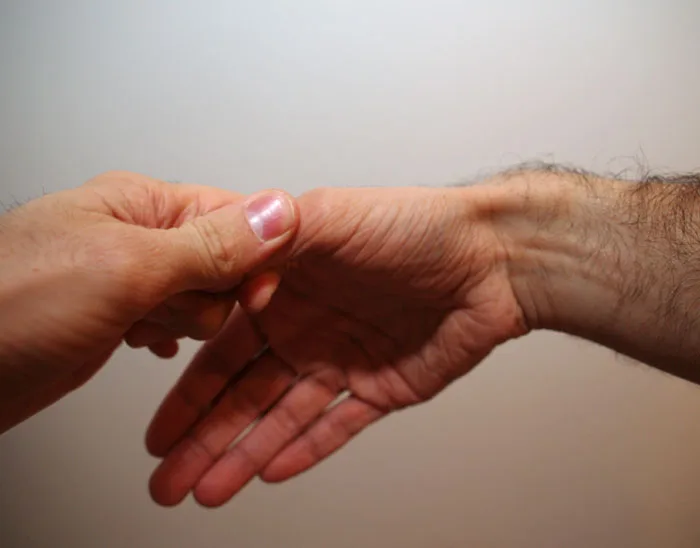
Image source: Wikimedia Commons / PhilippN (CC BY-SA)
The Pain Location Test (Thumb Side vs. Pinky Side vs. Center)
Press your thumb into your palm and make a fist. Now bend your wrist down toward your pinky. If you feel a sharp pain on the thumb side of your wrist, that’s a positive Finkelstein test.
It strongly suggests de Quervain’s tenosynovitis.
If the pain is on the pinky side, especially when you rotate your forearm or bear weight through your palm, suspect a TFCC injury. This is common in lifters who do a lot of pressing or pulling with a pronated (palms down) grip.
Pain in the center of your wrist, right where your hand meets your forearm, often points to a ligament sprain or general tendinitis. If you can point to the exact spot with one finger, that’s a good sign it’s a specific structure rather than general inflammation.
The Clicking and Popping Check
A painless click or pop is usually nothing to worry about. Your joints make noise for lots of reasons. But if that click comes with pain, it’s a different story.
Try moving your wrist through its full range of motion. Flex it up and down. Rotate it side to side.
If you feel a painful catch or grind, that could mean a torn ligament or a loose piece of cartilage inside the joint. This is worth getting checked out.
The Numbness and Tingling Red Flag
Numbness or tingling in your fingers is a serious sign. It means a nerve is being compressed. The pattern of numbness tells you which nerve.
- Numbness in your thumb, index, and middle fingers points to carpal tunnel syndrome (median nerve).
- Numbness in your pinky and ring finger points to ulnar nerve entrapment.
- Numbness on the back of your thumb and index finger points to radial nerve issues.
Any numbness that lasts longer than a few minutes after you stop lifting needs medical attention. Nerve compression can become permanent if left untreated.
Step-by-Step: What to Do Right Now If Your Wrist Hurts
You just finished a set and your wrist is throbbing. Here’s exactly what to do.
Immediate First Aid: RICE Protocol Done Right
Rest means stop the activity that caused the pain. Don’t test it. Don’t push through it.
If it hurts to grip a coffee cup, you’re done lifting for the day.
Ice the painful area for 15 to 20 minutes. Wrap the ice pack in a thin towel. Don’t put ice directly on your skin.
Do this every 2 to 3 hours for the first 48 hours.
Compression helps control swelling. An elastic bandage or a fitted wrist brace works well. Wrap it snug but not tight.
If your fingers turn purple or go numb, it’s too tight.
Elevation keeps fluid from pooling in your wrist. Prop your arm up on a pillow when you’re sitting or lying down. Keep it above heart level if you can.
When to Use a Brace or Splint (And When Not To)
A wrist brace can be helpful for acute pain. It limits movement and gives the injured tissue a chance to rest. Wear it during the day when you’re doing activities that might aggravate the injury.
Don’t wear it all the time. Your wrist needs some movement to maintain mobility and prevent stiffness. Take it off at night unless your doctor recommends otherwise.
Never use a brace as a substitute for proper form. If you need a brace to lift without pain, you’re not ready to lift that weight.
The “Can I Still Lift?” Decision Tree
Here’s a simple way to decide whether you can train around the injury.
Can you move your wrist through its full range of motion without pain?
- Yes: Go to the next question.
- No: Stop lifting. Rest for 3 to 5 days. Then reassess.
Can you grip a light object (like a coffee mug) without pain?
- Yes: Go to the next question.
- No: You need at least a week of rest. Consider seeing a doctor.
Is the pain a dull ache rather than a sharp stab?
- Yes: You can try modified lifting. Use a neutral grip. Drop the weight by 50%.
- No: Sharp pain means active injury. Stop lifting that body part.
Did the pain come on suddenly during a specific lift?
- Yes: This suggests an acute injury. Rest for 7 to 10 days. Seek medical evaluation if it doesn’t improve.
- No: Gradual onset usually means overuse. You can often manage this with rest and modified activity.
If you’re able to train, focus on exercises that don’t load your wrist. Leg work, core work, and machine-based exercises are your friends. Just watch your grip position closely.
If you’re doing any lower body work, pay attention to your form with exercises like the goblet squat to make sure you’re not compensating with your wrists.
The most important rule is this: pain is your guide. If something hurts, stop doing it. Find an alternative.
There’s always a way to train around an injury without making it worse.
Safe Lifting Modifications While You Recover
You don’t have to stop training completely. You just need to work around the injury. The goal is to keep your strength without loading the wrist.
Changing Your Grip: Neutral, Straps, and Hooks
Switch to a neutral grip wherever you can. That means palms facing each other instead of down. Dumbbells and EZ bars make this easier than a straight barbell.
Lifting straps can help during pulling exercises. They transfer the load from your grip to your forearm. This takes tension off the wrist joint.
For heavy deadlifts or rows, consider using straps or lifting hooks.
If you’re unsure how to set them up properly, our guide on how to use wrist straps for dumbbells walks through the technique step by step.
Exercises to Avoid Completely During Recovery
Stay away from any movement that forces your wrist into extreme extension or flexion. That means bench press with a straight bar, overhead press, and heavy farmer’s carries.
Also avoid exercises that load the wrist in a bent position. Push-ups on the floor, handstands, and front squats with a clean grip all put stress on healing tissue.
Exercises You Can Still Do Without Wrist Pain
You have plenty of options. Machine-based pressing keeps your wrist in a fixed neutral position. Cable work is gentle on the wrists.
Leg exercises like squats, leg presses, and lunges are safe as long as you don’t use your hands to stabilise the bar. Core work, stability ball exercises, and cardio are all on the table.
For upper body, focus on isolation movements that don’t require gripping. Lateral raises with cables, rear delt flyes, and tricep pushdowns with a straight bar attachment all bypass the wrist.
The 4-Week Rehab Plan: From Pain to Full Strength
This plan assumes you have a mild to moderate overuse injury, not a fracture or torn ligament. If you’re unsure, see a doctor first.
Week 1: Rest, Ice, and Gentle Range of Motion
No lifting that involves your wrists. Spend the first three days with RICE protocol. On day four, start gentle movement.
Wrist circles, finger stretches, and tendon glides. Move slowly. Stop if you feel sharp pain.
The goal is to maintain mobility, not to stretch aggressively.
Week 2: Isometric Strengthening (No Movement)
Isometrics build strength without moving the joint. Push your palm against a wall or table. Hold for 10 seconds.
Do 3 sets of 10 reps in each direction: flexion, extension, ulnar deviation, radial deviation.
You should feel a mild burn. If you feel sharp pain, back off the intensity.
Week 3: Eccentric Loading and Controlled Movement
Eccentrics are the gold standard for tendon rehab. Lower a light weight slowly over 3 to 5 seconds. Use a dumbbell or a resistance band.
Start with 2 to 5 pounds. Do wrist curls and reverse wrist curls. Focus on the lowering phase.
Do 3 sets of 12 reps every other day.
Week 4: Gradual Return to Lifting
Test with 50% of your normal working weight. Use a neutral grip. Do one set.
If there’s no pain the next day, increase by 10% each session.
If pain returns, drop back to isometrics for another week. Patience is the fastest path to full recovery.
Common Mistakes That Make Wrist Pain Worse (Don’t Do These)
These errors are why some people stay injured for months instead of weeks.
Ignoring Early Warning Signs
That mild ache after deadlifts is a message. So is the clicking sound when you rotate your wrist. If you push through these signals, you turn a minor tendinitis into a chronic tendinopathy that takes months to heal.
Relying Only on Wraps and Straps
Wraps and straps are tools, not solutions. They support the joint mechanically. But they don’t fix weak tendons or poor mobility.
If you need wraps for every heavy set, your wrists are telling you something.
Going Back to Heavy Lifting Too Soon
The temptation is real. You feel better after a week, so you load up the bar. Then the pain returns worse than before.
Tendons need time to remodel. That takes weeks, not days.
A good rule of thumb: wait until you can do a full workout at 60% of your previous max with zero pain. Then increase slowly.
Skipping Wrist Mobility and Warm-Ups
Cold tendons are brittle tendons. A proper warm-up increases blood flow and tissue temperature. Spend 5 minutes doing wrist circles, finger extensions, and light gripping before any upper body workout.
When you’re read planning your sessions, focus on warming up properly. The way you warm up for lateral raises with dumbbells or any pressing movement sets the stage for wrist health.
When to See a Doctor or Physical Therapist
Some injuries need professional help. Here’s how to know.
Red Flags That Require Immediate Medical Attention
Go to a doctor or urgent care if you have any of these:
- Obvious deformity or a bone that looks out of place
- Inability to move your wrist at all
- Numbness or tingling that doesn’t go away after a few minutes
- Severe swelling that appears within minutes of the injury
- A popping sound at the moment of injury followed by sharp pain
These could indicate a fracture, dislocation, or nerve compression that needs prompt treatment.
What to Expect at a Doctor’s Visit
Your doctor will ask about how the injury happened and where it hurts. They may order an X-ray to rule out a fracture. If they suspect a ligament or cartilage tear, they might order an MRI.
A physical therapist can assess your range of motion, strength, and movement patterns. Then they design a rehab program tailored to your specific injury and your lifting goals.
Treatment Options: PT, Injections, Bracing, and Surgery
Most wrist injuries respond to conservative care. Physical therapy is the first line treatment. Your PT will guide you through progressive loading and mobility work.
Corticosteroid injections can reduce inflammation in chronic tendinitis. But they weaken the tendon temporarily. You need a period of rest after an injection.
Surgery is usually reserved for complete ligament tears, fractures that don’t heal, or nerve compression that doesn’t respond to conservative treatment. Recovery from wrist surgery typically takes 6 to 12 weeks before you can lift again.
How to Prevent Wrist Pain from Lifting in the Future
Prevention is easier than rehab. Build these habits into your routine.
Essential Wrist Mobility Drills to Add to Your Routine
Do these every day, not just before lifting:
- Prayer stretch: palms together, lower wrists toward the floor
- Wrist circles: 30 seconds each direction
- Finger extensions: open your hand wide, hold for 5 seconds
- Tendon glides: make a fist, then straighten fingers one at a time
Two minutes of mobility work per day can prevent months of rehab.
Grip Strength Training That Protects Your Wrists
Strong forearms support your wrists. Farmer’s carries, dead hangs, and plate pinches all build grip strength without overstressing the wrist joint.
Use a gripper or hand putty for extra work. Do these on your off days. The stronger your grip, the less stress transfers to your wrist tendons.
Proper Lifting Technique for Every Major Lift
For pressing, keep your wrist neutral. Stack your knuckles over your elbows. For pulling, engage your lats before you pull the weight.
This takes some load off your grip.
Watch your bar placement during squats. A low bar position forces more wrist extension. High bar or front squats with straps are wrist-friendlier.
If you deadlift, use a mixed grip or hook grip to keep the bar from rolling. This reduces the need to squeeze the bar tightly, which fatigues your wrist flexors.
Take time to learn your form on key lifts. Understanding what do dumbbell bench press work or any pressing motion helps you identify where wrist stress comes from.
The Bottom Line: Your Wrist Pain Is Manageable If You Handle It Right
Most wrist injuries from lifting heal completely with conservative care. The key is catching it early and respecting the recovery process.
Frequently Asked Questions
How long does wrist pain from lifting usually last?
Mild tendinitis or sprains typically resolve in 2 to 6 weeks with proper rest and rehab. More serious injuries like TFCC tears can take 8 to 12 weeks. Chronic cases that have been ignored for months may take longer.
Can I keep lifting with wrist pain?
It depends on the severity. If the pain is a dull ache that goes away after warming up, you can modify your training. Use a neutral grip and drop the weight by 50%.
If you feel sharp pain or numbness, stop lifting that body part completely.
Should I use a wrist brace while sleeping?
Yes, if you have tendinitis or carpal tunnel symptoms. A night splint keeps your wrist in a neutral position. This prevents you from curling your wrist under your pillow, which compresses the nerves and tendons.
Are wrist wraps bad for you?
No, but they have a purpose. Wrist wraps support the joint during heavy lifts. They are not a substitute for wrist strength or mobility.
Use them for max effort sets, not for every warm-up rep.
When should I see a doctor for wrist pain?
See a doctor if you have numbness or tingling, if the pain lasts more than two weeks with rest, or if you heard a popping sound at the moment of injury. Also go if you can’t move your wrist or if there is visible deformity.
Can stretching alone fix wrist pain?
Stretching helps maintain mobility, but it rarely fixes the root cause. Most lifting-related wrist pain comes from weak tendons or poor form. You need strengthening exercises and technique adjustments, not just flexibility work.