How to Store Dumbbells in Small Spaces: Smart Tips
You step into your home gym. It’s a small space, a corner of the bedroom or a spare closet. And there they are: dumbbells scattered across the floor.
You need to know How to Store Dumbbells in Small Spaces without giving up your workout area.
In our research, the average home gym owner with a 5-to-50-pound set of fixed dumbbells needs roughly 3 to 4 square feet of dedicated storage space. That’s a lot when you’re working with a 10×10 room. The right storage method depends on three things.
Let’s walk through them.
The “Dumbbell Floor Pile” Problem
Leaving dumbbells on the floor is the default for most people. It’s easy. You finish a set, drop the weight, and move on.
But that pile creates real problems.
Trip hazards are the biggest concern. You step over a 50-pound dumbbell in the dark. That’s a broken toe or a sprained ankle waiting to happen.
The Consumer Product Safety Commission offers safety guidelines for home fitness equipment that recommend keeping weight plates off the floor to prevent accidents.
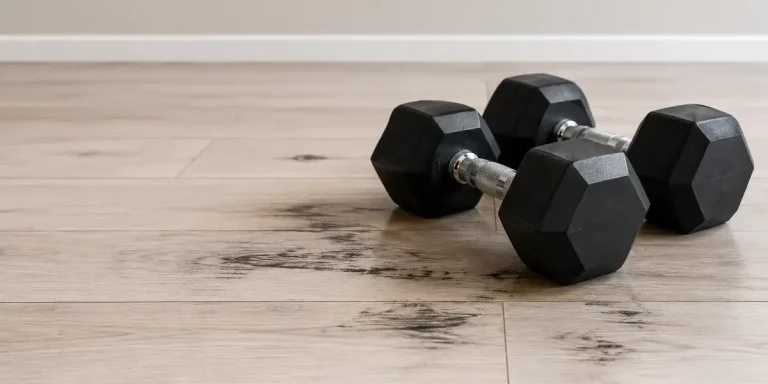
Floor damage is another issue. Rubber hex dumbbells can scuff hardwood. Iron ones dent laminate.
And the noise? Neighbors in an apartment will hear every drop.
The solution isn’t complicated. It just requires a plan. And that plan starts with knowing what you’re working with.
Quick Answer
Store dumbbells in small spaces by choosing the right rack. Your options depend on dumbbell type and room size. Fixed sets need a tiered or vertical rack.
Adjustable dumbbells stay on their base. Renters should use freestanding or rolling storage.
Step 1: What Kind of Dumbbells Do You Actually Have?
This is the first decision point. Your dumbbell type determines your storage options. Let’s cover the two main categories.
Fixed dumbbells are one piece. Each weight is a separate dumbbell. You’ll see rubber hex, urethane, and iron versions.
If you own a set from 5 to 50 pounds, that’s 10 pairs. You need a rack that holds multiple pairs.
Adjustable dumbbells use a single handle with weight plates. There are two main types. Selectorized models like PowerBlock and Bowflex use a dial or pin to change weight.
They come with a base or cradle. Plate-loaded models use standard weight plates with a shorter sleeve. They need a separate weight tree.
If you’re not sure which type you have, look at the base. Fixed dumbbells don’t have one. Adjustable dumbbells sit in a cradle or on a tray.
Getting the most out of a selectorized set starts with understanding its storage needs.
Step 2: Measure Your Space (For Real)
This is where most people guess. Don’t. Grab a tape measure and get the actual numbers.
Start with floor space. Where will the rack go? Measure the length and width.
A 3-tier rack usually needs about 2 by 3 feet. A vertical rack needs about 1.5 by 2 feet. Write it down.
Next, check your wall space. If you’re mounting a rack, measure the wall width. Find the studs.
Most wall-mounted racks need 16-inch or 24-inch stud spacing. You can’t mount directly to drywall.
Now measure your ceiling height. Some vertical racks are 6 feet tall. You need clearance to lift the dumbbells off the top row.
If your ceiling is 7 feet, you’re fine. If it’s 8 feet, even better.
Don’t forget the door. If you’re buying a rack, measure your door frame. Some racks are assembled and won’t fit through a standard 30-inch door.
Measure first.
Giving yourself room to move is just as important as the storage itself. You need space to actually use the dumbbells.
Step 3: The Decision Tree — Fixed vs. Adjustable Dumbbells
Now you know what you have and where it’s going. Let’s pick the right storage method.
Branch A: You Have Fixed Dumbbells
You have a set of individual weights. Each one is a different pair. Your storage goal is to keep them organized and accessible.
A-frame racks are the most common. They hold 3 to 5 pairs in a compact footprint. The dumbbells sit in a V-shape, easy to grab.
They’re freestanding and don’t need drilling.
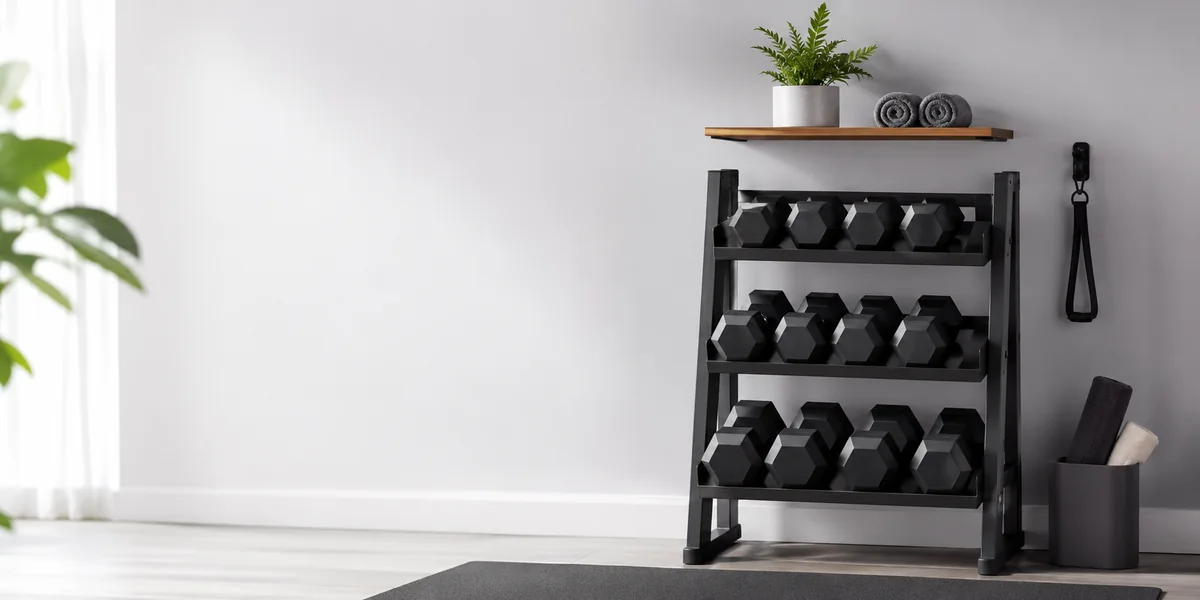
3-tier racks hold more. You can fit 6 to 10 pairs. They’re wider and more stable.
They take up more floor space but give you room to grow.
Vertical wall-mounted racks save floor space. They mount to the wall and hold the dumbbells upright. They need drilling and stud mounting.
They’re great for small spaces but harder to access the top pairs.
If you have 3 to 5 pairs, use an A-frame. If you have 6 or more pairs, use a 3-tier rack. If you’re tight on floor space and can drill, use a wall-mounted rack.
Branch B: You Have Adjustable Dumbbells
Adjustable dumbbells are simpler to store. The base or cradle is designed for the weight.
Selectorized models like PowerBlock and Bowflex should stay on their base. Don’t put them on a standard rack. The base holds the weight plates and the handle.
Some models offer a tray or stand for extra stability.
Plate-loaded adjustable dumbbells need a small weight tree. You can store the plates on the tree and the handle on a hook. Keep the plates organized by weight.
If you have common issues with adjustable models, check the base first. A misaligned cradle can cause problems.
Branch C: You’re a Renter (No Drilling)
You can’t mount anything to the wall. That’s okay. You have options.
Freestanding racks are your best bet. A-frame and 3-tier racks don’t need wall anchors. They sit on the floor and hold the weight.
Rolling carts are another option. Some dumbbell trees come with wheels. You can roll them into a closet or corner.
They’re portable and easy to move.
Under-bed storage works for lighter sets. Some adjustable dumbbells fit under a bed. Use a pull-out tray or a shallow container.
Focus on freestanding options. Measure the footprint. Make sure the rack doesn’t tip over.
Keeping your workout space safe is the priority.
Branch D: You Need to Hide Them
Maybe you want your home gym to look like a regular room. That’s possible.
Storage ottomans are a popular choice. They look like furniture but hold dumbbells inside. Some are designed for gym equipment.
Measure the interior dimensions before buying.
Under-bed storage with a pull-out tray works for lighter sets. You can slide the tray out, grab the weight, and slide it back.
Decorative trunks and benches are another option. They can hold several pairs of dumbbells. Make sure the lid closes securely.
Look for furniture that doubles as storage. Measure the interior dimensions. Don’t overload the furniture.
Most ottomans are rated for 100 to 200 pounds.
Common Mistakes That Waste Space or Damage Your Floor
Most people make the same errors when setting up dumbbell storage. Here are the ones we see most often.
Overloading the rack. Every rack has a weight limit. A 3-tier rack rated for 300 pounds can’t hold a full set of 5-to-100-pound dumbbells. Check the spec.
Overloading bends the frame and creates a tip hazard.
Putting heavy dumbbells on the top row. Gravity works against you. A 50-pound dumbbell on the top shelf of a vertical rack is hard to lift down. It’s also unstable.
Keep the heaviest weights on the bottom row. That’s where the center of gravity belongs.
Ignoring floor protection. Rubber mats are not optional. They protect your floor from scratches and dents. They also reduce noise.
A 3/8-inch rubber stall mat costs about $40. It’s the cheapest insurance you can buy.
Forgetting about accessibility. You want to grab and go. If you have to move a bench or a fan to get to your dumbbells, you’ll skip the workout. Keep the most used weights at eye level or waist level.
Buying a rack that doesn’t fit. Measure your dumbbells before you buy. A pair of 50-pound hex dumbbells is about 14 inches long. A rack that’s 12 inches wide won’t hold them.
Check the specs.
Real-World Examples: What Worked for Different Spaces
Let’s look at three common scenarios. Each one has a different solution.
Scenario 1: The apartment corner (8×8 feet). You have a set of adjustable dumbbells up to 50 pounds. You also have a folding bench. The solution is a rolling cart.
You can roll the dumbbells and bench into a closet when not in use. The cart takes up 2 square feet. The bench folds flat against the wall.
Total workout time setup is 30 seconds.
Scenario 2: The spare bedroom (10×12 feet). You have a full set of fixed hex dumbbells from 5 to 50 pounds. That’s 10 pairs. The solution is a 3-tier rack against the wall.
It takes up 3 square feet. You add a rubber mat underneath. The rack holds all 10 pairs.
You can access any weight without moving anything.
Scenario 3: The shared living room (no dedicated space). You have a pair of adjustable dumbbells up to 25 pounds. The solution is a storage ottoman. It looks like a piece of furniture.
The dumbbells sit inside. You pull them out for workouts and put them away after. The ottoman doubles as a seat.
Zero visual clutter.
If you’re working with a dedicated space, proper form matters. You can continue building your routine with exercises like the single arm dumbbell row without worrying about tripping over loose weights.
Your Decision Guide: A Simple Checklist
Use this checklist to find your storage solution in under 5 minutes.
| Question | If Yes | If No |
|---|---|---|
| Do you have fixed dumbbells? | Go to row 2 | Go to row 3 |
| Do you have 3 to 5 pairs? | A-frame rack | 3-tier rack |
| Do you have adjustable dumbbells? | Keep them on their base | Get a small weight tree |
| Can you drill into walls? | Vertical wall-mounted rack | Freestanding rack or cart |
| Do you need to hide the dumbbells? | Storage ottoman or trunk | Open rack or cart |
| Is your floor hardwood or laminate? | Rubber mat required | Rubber mat recommended |
If you checked “Yes” for most of these, you’re on the right track. One more thing to consider: how you’ll keep the rack stable over time.
Keeping It That Way: Maintenance Tips
A good rack lasts years. But only if you maintain it.
Tighten the bolts every 3 months. Vibration from lifting loosens nuts and bolts. A loose rack wobbles. A wobbling rack tips.
Use a wrench, not a screwdriver. Lock washers help.
Check for rust monthly. If your dumbbells are in a basement or garage, moisture is the enemy. Wipe down the rack and dumbbells with a dry cloth after each use. A coat of silicone spray on the rack prevents rust.
Inspect the floor mat. Rubber mats shift over time. If the mat slides, the rack can move. Use double-sided tape or a non-slip pad under the mat.
Replace it if it cracks.
Keep the weight organized. Dumbbells should sit in the correct slots. A 20-pound dumbbell in a 30-pound slot creates a gap. The rack becomes unstable.
It also makes noise. Put each weight in its proper place.
Lubricate moving parts. If your rack has a rotating mechanism or a telescoping stand, use a dry lubricant like silicone spray. Do not use WD-40. It attracts dust.
Dry lubricant keeps things smooth and clean.
Frequently Asked Questions
Can I store dumbbells under my bed?
Yes, if the dumbbells are lightweight and the bed frame has at least 6 inches of clearance. Use a pull-out tray or a shallow storage container. Keep the total weight under 100 pounds to avoid damaging the bed frame.
Do I need a rack for adjustable dumbbells?
Most adjustable dumbbells come with a base or cradle designed for storage. You don’t need a separate rack. For plate-loaded adjustable dumbbells, a small weight tree keeps the plates organized.
How much weight can a wall-mounted rack hold?
It depends on the model and the wall studs. Most wall-mounted racks are rated for 200 to 500 pounds total. Check the manufacturer’s spec.
Mounting into wood studs is stronger than concrete anchors.
What’s the best storage for a set of 5 to 50 pound dumbbells?
A 3-tier freestanding rack is the most practical choice. It holds 10 pairs in about 3 square feet of floor space. It’s stable, easy to access, and doesn’t require drilling.
Can I store kettlebells on the same rack?
Some racks are designed for both dumbbells and kettlebells. Look for a rack with a flat top shelf or a kettlebell peg. If the rack is not designed for kettlebells, they may roll off or create an imbalance.
Proper storage keeps your equipment in good shape for a long time.