
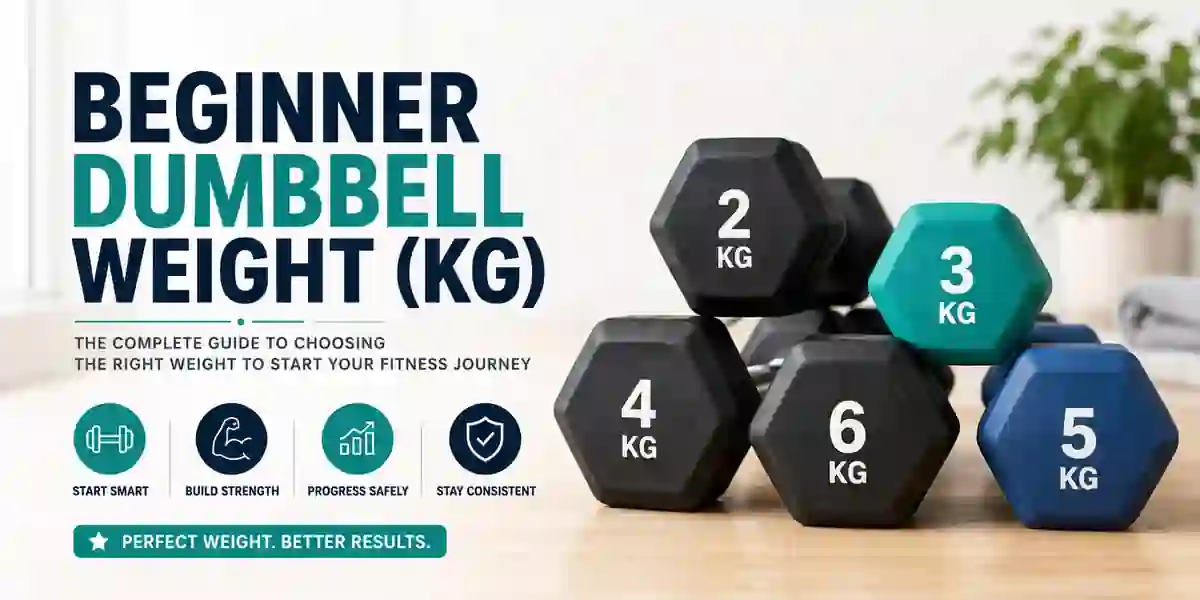
Beginner Dumbbell Weight KG: How Heavy Should You Lift?
So you’re standing in the gym or scrolling through an online store, staring at dumbbells that range from 1 kg to 20 kg, and you have no clue which pair to grab. You’re not alone. Finding the right beginner dumbbell weight in kg can feel surprisingly complicated for something that looks so simple.
Pick too light, and you won’t see any progress. Pick too heavy, and you risk injury or horrible form.
The good news is that the right weight isn’t a mystery. It’s a range you can figure out in about five minutes with a simple test. In our research, based on guidelines from the American College of Sports Medicine (ACSM) and the National Strength and Conditioning Association (NSCA), most untrained adults should start with a specific weight range that varies by exercise and individual strength.
Let’s walk through exactly how to find yours.
Quick Answer
Most beginners should start with 2 to 6 kg per dumbbell for upper body exercises. Start with 4 to 10 kg for lower body exercises. Women typically start at the lower end.
Men typically start at the higher end. Test each weight with a warm-up set before committing.
Why Getting the Right Weight Matters
Picking the wrong dumbbell weight is the single fastest way to waste your time in the gym. If you go too light, you’ll complete 20 reps without breaking a sweat. Your muscles won’t get the stimulus they need to grow or get stronger.
You’ll feel frustrated and wonder why you’re not seeing results after weeks of effort.
If you go too heavy, the opposite happens. Your form breaks down. You start swinging your body to lift the weight.
Your shoulders or lower back take over instead of the muscle you’re trying to target. That’s how beginners get injured in their first month.
The ACSM’s resistance training guidelines recommend choosing a weight that allows you to complete 8 to 12 reps with good form while feeling significant fatigue by the last two reps. This is called the “repetition continuum,” and it’s the gold standard for building muscle and strength in beginners.
There’s also a psychological factor. Starting with a weight that feels manageable but challenging builds confidence. You learn proper technique without fear.
You’re more likely to stick with your routine for the long haul. That consistency matters more than any single workout.
The 3 Factors That Determine Your Starting Weight
Your Current Strength Baseline
Your starting weight depends heavily on your current fitness level. If you’ve never lifted weights before, your nervous system hasn’t learned to recruit muscle fibers efficiently yet. That means you’ll be weaker than someone who played sports or did physical labor, even if they never touched a dumbbell.
A completely untrained woman with no sports background might start with 2 kg for bicep curls. A man who did manual labor for years might start with 8 kg for the same exercise. Both are beginners.
Both are right for their situations.
The Specific Exercise You’re Doing
This is the factor most people overlook. You cannot use the same weight for every exercise. Your lower body muscles are significantly stronger than your upper body muscles.
Your glutes and quads can handle much more load than your shoulders or biceps.
Here’s a quick breakdown of how weight changes by exercise type:
| Exercise Type | Example | Typical Beginner Weight Range (per dumbbell) |
|---|---|---|
| Upper body isolation | Bicep curls, tricep extensions, lateral raises | 1 to 6 kg |
| Upper body compound | Chest press, shoulder press, rows | 4 to 12 kg |
| Lower body compound | Goblet squats, lunges, deadlifts | 6 to 16 kg |
If you pick a weight that works for bicep curls and try to use it for goblet squats, you’ll get zero benefit from the squats. If you pick a weight that works for squats and try to curl it, you’ll hurt yourself.
Your Training Goal
What are you trying to achieve? The answer changes your ideal weight range.
If your goal is muscle growth (hypertrophy), you want a weight that lets you complete 8 to 12 reps with the last two feeling very hard. If your goal is muscular endurance, you want a lighter weight that lets you do 15 to 20 reps. If your goal is pure strength, you want a heavier weight that limits you to 4 to 6 reps.
For most beginners, starting with the 8 to 12 rep range for muscle growth is the smartest approach. It builds a solid foundation. It teaches your body to handle load safely.
You can adjust later as your goals become clearer.
How to Test Your Starting Weight in 5 Minutes
You don’t need to guess. You can test your starting weight with a simple method that takes almost no time.
The Warm-Up Set Method
Pick a dumbbell that looks reasonable. Perform 10 reps of the exercise you want to do. Pay close attention to how the last two reps feel.
If you can complete all 10 reps with perfect form and the last two feel easy, the weight is too light. Go up in weight and try again.
If you can’t complete 8 reps without breaking form, the weight is too heavy. Go down.
If you complete 8 to 10 reps and the last two are very difficult but you maintain good form, you’ve found your starting weight.
The “Last 2 Reps” Form Check
This is the most reliable indicator. Your form should look identical on rep 1 and rep 10. If you start swinging, shrugging, leaning back, or using momentum on the last two reps, the weight is too heavy.
Your form is your safety net. Never sacrifice it for a heavier weight. If you’re unsure about proper form for specific exercises, our guide on how to properly lift dumbbells covers the fundamentals you need to know before loading up.
When to Go Up or Down
If you can easily do 15 reps with perfect form, increase the weight by 1 to 2.5 kg for upper body exercises or 2.5 to 5 kg for lower body exercises.
If you can’t do 6 reps with good form, drop the weight by the same increment.
This test works for every exercise. Do it for each new movement you try. Your starting weight for bicep curls will be different from your starting weight for rows, and that’s completely normal.
Weight Range by Exercise
This section gives you concrete numbers to work with. These are research-backed ranges for untrained adults using the 8 to 12 rep range standard.
Upper Body Isolation Exercises
| Exercise | Typical Beginner Weight (per dumbbell) |
|---|---|
| Bicep curls | 2 to 6 kg |
| Tricep extensions | 2 to 6 kg |
| Lateral raises | 1 to 4 kg |
| Front raises | 2 to 5 kg |
| Overhead tricep extension | 3 to 7 kg |
Lateral raises are the exception here. The shoulder joint is mechanically disadvantaged in this movement. Even strong lifters rarely use more than 8 to 12 kg for lateral raises.
Start at the very bottom of this range and work up slowly.
Upper Body Compound Exercises
| Exercise | Typical Beginner Weight (per dumbbell) |
|---|---|
| Dumbbell bench press | 4 to 12 kg |
| Dumbbell shoulder press | 4 to 10 kg |
| Bent-over rows | 5 to 14 kg |
| Single-arm rows | 6 to 16 kg |
Compound exercises use multiple muscle groups, so you can handle more weight. If you’re doing a proper single-arm dumbbell row, you might use 8 to 12 kg even as a beginner. Your back muscles are strong.
Lower Body Exercises
| Exercise | Typical Beginner Weight (per dumbbell) |
|---|---|
| Goblet squats | 6 to 16 kg |
| Dumbbell lunges | 5 to 14 kg |
| Dumbbell deadlifts | 8 to 20 kg |
| Hip thrusts | 6 to 16 kg |
| Calf raises | 8 to 20 kg |
Your legs can handle significantly more weight than your upper body. A beginner who uses 4 kg for bicep curls might use 12 kg for goblet squats. That’s not unusual.
That’s anatomy.
When you’re learning exercises like the dumbbell deadlift, start conservatively. Your lower back needs time to develop stability before you load it heavily. Our step-by-step guide on how to do dumbbell deadlifts can help you nail the form first.


2 Comments