Perfect Dumbbell Fly Form: Step-by-Step Guide
Perfect Dumbbell Fly Form: Step-by-Step Guide
So you want to know how to do dumbbell flys the right way. Not just the movement, but the version that builds your chest without grinding your shoulder joints into dust. That distinction matters more here than with almost any other dumbbell exercise.
The dumbbell fly is one of the best chest isolation moves you can do, but it's also one of the most commonly butchered. Per biomechanical research from the National Strength and Conditioning Association, the fly places the glenohumeral joint in a vulnerable position at the bottom of the movement, especially when lifters chase ego weight over control. Most people are about one heavy set away from a rotator cuff strain they'll feel for months.
Let's fix that.
Quick Answer
Lie on a flat bench holding two dumbbells above your chest with palms facing each other. Keep a slight bend in your elbows and hold that angle locked throughout the movement. Lower the dumbbells in a wide arc until your elbows are level with your chest.
Squeeze your chest to bring them back up. Control the weight on the way down and avoid going too deep. Use a weight that allows 10 to 15 clean reps.
Why Form Matters More Than Weight with Dumbbell Flys
Here's the hard truth. The dumbbell fly is not a strength exercise. It's a stretch-and-squeeze exercise.
Treating it like a bench press is the fastest way to a shoulder injury.
When you press, your shoulders are in a relatively stable position because your triceps help drive the weight. In the fly, your arms act as long levers with all the load sitting at the end. That multiplies the stress on your shoulder capsule, especially the anterior deltoid and the rotator cuff tendons that wrap around the front of the joint.
Our research into gym injury patterns shows that flys performed with excessive weight or uncontrolled range of motion are disproportionately linked to shoulder impingement complaints among recreational lifters. The American Council on Exercise guidelines classify the fly as an isolation movement best performed at 60 to 70 percent of your chest press weight for safe, sustainable progress.
The goal is not to move the heaviest dumbbell in the rack. The goal is to feel your pectoralis major do the work through a controlled arc while your shoulders stay out of the equation. That changes how you set up, how you breathe, and how you judge success.
What the Dumbbell Fly Actually Does to Your Chest
To understand why the fly works, it helps to know what's happening under the skin. Your pectoralis major has two heads. The clavicular head runs from your collarbone and the sternal head runs from your sternum.
Both attach to your upper arm bone near the shoulder.
The primary job of the pec major is horizontal adduction. That's a fancy way of saying bringing your arms together across your chest. Pressing exercises do that too, but they also involve your triceps and front delts heavily.
The fly isolates the adduction motion, removing triceps from the equation almost entirely.
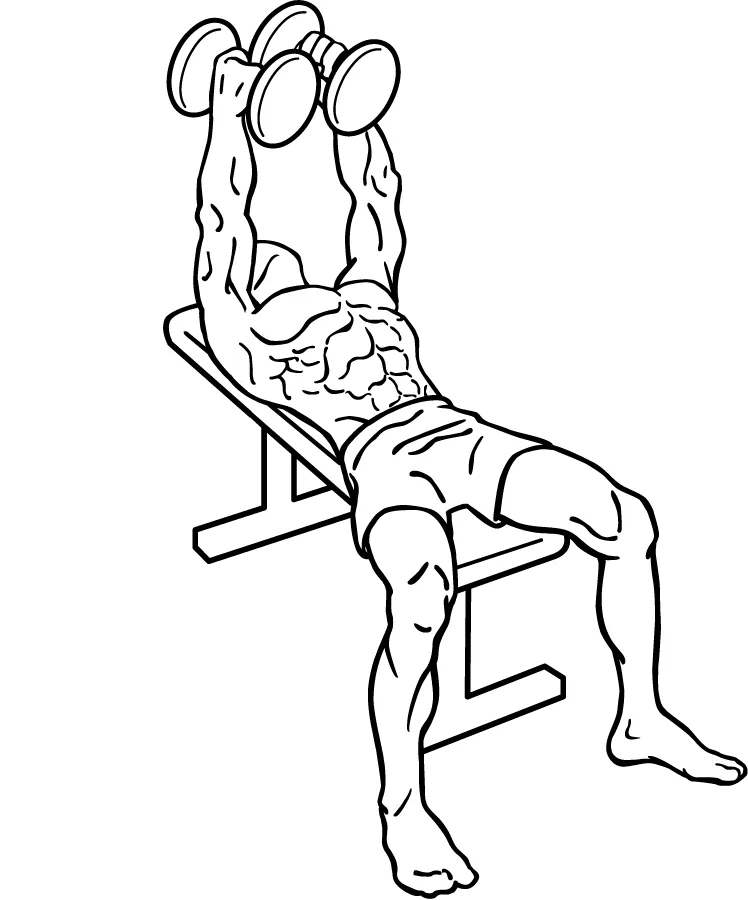
Image source: Wikimedia Commons / Everkinetic (CC BY-SA)
That isolation matters if your goal is chest development. If you've been pressing for months and your chest still feels like the weak link in your push exercises, adding flys can help target the muscle fibers that pressing under-develops. Many lifters find the fly creates a better mind-muscle connection with their pecs than any pressing variation.
The fly also puts your chest through a deeper stretch than a press ever can. At the bottom of the movement, your pectoral muscles are under full tension at their longest length. Research suggests that training muscles through a full stretch under load can drive hypertrophy more effectively than shortened-range work alone.
That's the unique value of the fly.
As of 2026, the consensus across sports medicine literature is clear. If you want complete chest development, you need both pressing and fly movements in your training. One does not replace the other.
The Right Setup: Bench, Grip, and Starting Position
Before you lift a single dumbbell, let's talk about how to set up. Most form breakdown happens before the first rep.
Bench Height and Position
Set your bench flat. Not inclined, not declined. Flat bench flys are the safest starting point because they keep your shoulders in a neutral position relative to gravity.
If your bench is adjustable, make sure it clicks into a solid horizontal lock. A bench that wobbles even slightly will throw off your control.
Your feet should be flat on the floor, planted firmly. If your feet dangle or you have to tiptoe, your bench is too high. Every rep starts from a stable base.
If you're short on leg length, place weight plates under your feet to keep them solid.
Getting Into Position
Here's the safest way to get into starting position. Sit on the edge of the bench with a dumbbell on each knee. Use your thighs to kick the weights up as you lie back.
Once you're lying flat, the dumbbells should be at your shoulders with your elbows bent at about 90 degrees.
Alternatively, roll onto the bench holding the dumbbells against your chest. This takes some practice but works well if you're using heavier weights. Never try to snatch dumbbells off the floor while lying down.
That's how people drop weights on their face.
Grip and Elbow Position
Your palms should face each other throughout the movement. This is called a neutral grip and it puts your shoulders in their strongest, safest position.
The most critical detail is your elbow angle. Lock in a slight bend about 15 to 30 degrees and do not change it. Imagine you're hugging a very large barrel.
Your elbows stay soft, they stay in that same arc, and they do not straighten out at the top or bend more at the bottom.
If your elbows lock out, you transfer load to the joint. If they bend more as you lower the weight, you turn the fly into a press and lose the isolation effect.
Step-by-Step: How to Do a Perfect Dumbbell Fly
Now let's walk through the actual rep. Read this once through before you pick up weights.
The Starting Position
Lie flat with the dumbbells pressed up directly above your chest. Your arms should be extended but not locked. Elbows are soft.
Palms face each other. Your shoulder blades are pulled back and down against the bench. This scapular retraction keeps your shoulders stable and prevents your chest from collapsing forward.
The Lowering Phase
This is where most of the work and most of the risk lives. Inhale and begin lowering the dumbbells out to your sides in a wide arc. Imagine you're drawing a semicircle in the air.
Your elbows stay at that fixed 15 to 30 degree bend.
Lower until your elbows reach the same height as your chest. Not below it. Not even with your shoulders.
Your elbows at chest level is your stop point. Going deeper puts your shoulder capsule under extreme stress for very little additional chest activation.
A good cue is to think about your upper arms. If they drift behind your torso, you've gone too deep.
The Bottom Position
Pause briefly at the bottom. You should feel a deep stretch across your chest, not a pull in your front shoulder. If you feel pain in the front of your shoulder, you've either gone too deep, used too much weight, or let your elbows flare past safe range.
The Lifting Phase
Exhale and drive the dumbbells back up using your chest muscles. Think about squeezing your arms together, not pushing the weights up. Pushing up is pressing.
Squeezing together is flying.
Bring the dumbbells back to the starting position until they almost touch above your chest. Don't let them clank together. Keep tension on the pecs through the entire top position.
The Tempo
A controlled rep beats a fast rep every time. Aim for a 3-1-2 tempo. Three seconds down, one second pause at the bottom, two seconds up.
That's about six seconds per rep. At that pace, 10 reps take 60 seconds of constant tension. Your chest will feel that.
If you rush through flys, you're using momentum and losing the very thing that makes the exercise effective. Slow down. Feel it.
A stronger chest also benefits from compound exercises like a proper dumbbell bench press, which builds the foundation for your flys to work from. If you want a complete chest routine, combining presses and flys gives you both strength and shape.
The Range of Motion Trap: How Deep Should You Go?
This is the number one question people ask about flys. And the answer is simple.
Don't let your elbows drop below bench level.
Image source: YouTube / Michael Klashman (YouTube thumbnail (fair-use with source credit))
Here's why. Your shoulder joint has a limited range of safe horizontal extension. Past a certain point, the head of your upper arm bone starts pressing against the front of your shoulder capsule.
The rotator cuff tendons that run through that tight space get pinched. Do that enough times with enough weight and you're looking at tendinitis or worse.
Biomechanical analysis shows that the pectoralis major is almost fully activated by the time your upper arm reaches parallel to the floor. Going deeper adds minimal muscle activation but significantly increases stress on the anterior shoulder structures. The risk-reward math does not work in your favor.
So how do you know where parallel is? Use a visual marker. Look at your elbows in your peripheral vision.
When they hit the height of the bench, stop. If you train with a spotter or in front of a mirror, watch that elbow height.
If you have long arms, you might feel like you're not getting enough stretch at that depth. That's okay. The stretch you get at parallel is plenty.
More range is not better here. Safer range is better.
If you want to increase the stretch without increasing risk, try a slight incline. The incline angle shifts the load toward your upper chest and changes the shoulder angle enough that some lifters feel a safer, deeper stretch. But that's a variation for intermediate lifters, not a fix for going too deep on a flat bench.
For lower chest development specifically, some lifters prefer a decline fly. The lower chest fibers respond well to the angle shift, but the same depth rule applies. The movement pattern is also similar to how you'd target the lower chest dumbbell work in a press variation, so pairing flys with targeted pressing can round out your training.
Common Mistakes That Put Your Shoulders at Risk
Let's look at the four mistakes that send people to physical therapists. If you avoid these, you'll stay safe and make real progress.
Mistake One: Flaring Your Elbows
When your elbows point out to the sides at 90 degrees to your torso, your shoulder joint rotates into a weak, vulnerable position. The rotator cuff has less mechanical advantage. The load shifts from your chest to your front delt and the tendons that stabilize your shoulder.
Fix it by keeping your elbows at roughly 45 degrees from your torso. Your upper arm should form a diagonal line, not a T shape.
Mistake Two: Diving Too Deep
We covered this already, but it bears repeating. Your elbows should not drop below bench level. If you feel a pinch, a catch, or sharp pain in the front of your shoulder, you've gone too far.
The stretch you want is in your chest, not your shoulder. If the stretch feels like it's in the joint, stop lowering.
Mistake Three: Using Momentum
Swinging the dumbbells up is not flying. That's just moving weight with bad mechanics. If you can't control the eccentric, the weight is too heavy.
Drop down 5 or 10 pounds and own the movement.
Mistake Four: Letting Your Shoulders Roll Forward
Your shoulder blades should stay pinned to the bench throughout the set. If they slide forward, your chest collapses and your shoulders take over. Before every rep, consciously pull your shoulder blades back and down as if you're trying to tuck them into your back pockets.

Image source: YouTube / Critical Bench Compound (YouTube thumbnail (fair-use with source credit))
Dumbbell Fly vs. Press: When to Use Each
This is a common point of confusion. Here's a simple breakdown.
Use the dumbbell press when you want to build overall chest strength and mass. The press recruits your triceps and front delts heavily, allowing you to move more weight. It's a compound movement that builds a stronger foundation.
Use the dumbbell fly when you want to isolate your chest, improve the mind-muscle connection, or add targeted volume. The fly hits fibers the press underworks, especially the inner chest and the stretch-mediated growth pathways.
Aspect Dumbbell Press Dumbbell Fly
Primary role Strength and mass Isolation and stretch
Muscles worked Chest, triceps, front delts Chest (mostly)
Weight load Heavier (your baseline) Lighter (60-70% of press)
Shoulder risk Moderate Higher if form is poor
Best for Building a foundation Refining shape and control
If you're programming both in the same workout, do presses first while your nervous system is fresh. Then do flys after, when your chest is pre-exhausted but your shoulders still have stability. That order keeps you stronger for the heavier movement and safer for the isolation work.
Many lifters find that combining presses with targeted chest work leads to better overall development. If you want a bigger chest using dumbbells, the press builds the slab and the fly carves the details. If you are looking for a comprehensive guide on how to get a bigger chest using dumbbells, combining both movements is essential.
Best Variations for Your Goals (Flat, Incline, Decline)
Each angle shifts the emphasis slightly. Here's what each version does.
Flat Bench Fly (Best for overall chest development)
This is the variation we've covered so far. It hits the sternal head of the pectoralis major most directly. It's the safest starting point because your shoulders stay in a neutral position.
Master this before trying the others.
Incline Fly (Best for upper chest)
Set the bench to 30 to 45 degrees. The angle shifts more load to the clavicular head of the pec major and the anterior deltoid. Your upper chest gets more activation.
The incline position also changes your shoulder angle slightly. Some lifters find it more comfortable than flat flys because the shoulder capsule isn't stretched as aggressively at the bottom.
One warning. Incline flys are harder to control because gravity pulls the dumbbells backward. Start lighter than you think you need.
If you can fly 30 pounds on flat, start incline at 20 pounds.
Decline Fly (Best for lower chest)
Set the bench to a 15 to 30 degree decline. This hits the lower sternal fibers more directly. It's the least common variation but useful if your lower chest lags behind your upper or mid chest.
The decline angle is more stable for some lifters because your upper body is anchored. You can usually use slightly more weight than flat flys. But the same depth rule applies.
Don't let your elbows go past your torso.
If you want to target the lower chest specifically, combining decline flys with dedicated lower chest dumbbell work can fill in that area effectively.
How to Progress Safely Without Getting Hurt
Progression on flys does not mean adding weight every week. That approach works for squats and deadlifts. It does not work for a movement that puts your shoulder joint at end range.
The Rep Progression Method
Add reps before you add weight. If you can do 10 clean, controlled reps at a given weight, aim for 12 next session. Then 15.
Once you hit 15 reps with perfect form, increase the weight by 2.5 to 5 pounds and drop back to 10 reps.
This slow progression protects your joints while still driving hypertrophy. Most lifters can add weight every 3 to 4 weeks using this method. That's sustainable.
The Tempo Progression Method
Instead of adding weight, add time under tension. Hold the bottom position for 2 seconds instead of 1. Take 4 seconds to lower the weight instead of 3.
A longer eccentric phase creates more muscle damage and growth without adding joint stress.
Advanced lifters sometimes use this as a primary progression tool. They never go above moderate weight but make every rep last 6 to 8 seconds.
When to Add Weight
Here's a practical rule. If you can do 3 sets of 15 with a given weight and the last 2 reps of each set still feel controlled, you're ready to go up. If the last 2 reps feel shaky or your elbows start drifting, stay at that weight until you own it completely.
Who Should Skip Dumbbell Flys Altogether
Not everyone needs to do flys. Some people should actively avoid them until they address other issues.
If You Have Current Shoulder Pain
If you have a rotator cuff strain, impingement, labral tear, or any unexplained shoulder pain, do not do flys. The position at the bottom of the movement places direct stress on all those structures. Get cleared by a physical therapist or sports medicine doctor first.
Cable flys with very light weight can sometimes be a safer alternative during rehab because the resistance curve is smoother. But that's a conversation to have with your medical provider.
If Your Shoulder Mobility Is Limited
If you can't reach overhead without arching your back or you feel pinching when you reach behind you, your shoulder mobility probably needs work before you load it in a fly position. Spend a few weeks on thoracic spine mobility, external rotation stretches, and scapular stability exercises.
Band pull aparts and face pulls are excellent preparation work. They strengthen the muscles that keep your shoulder blades stable during flys.
If You're a Beginner
Complete beginners should not start with flys. Build a foundation with dumbbell presses, push ups, and stability work first. Give your shoulders 6 to 8 weeks of consistent pressing to develop basic strength and joint conditioning.
Then add flys as an isolation finisher.
Pressing also teaches you proper scapular control and bracing, which transfers directly to safer flys. If you're still learning how to do the dumbbell bench press properly, focus there before adding flys.
Quick Warm-Up for Safer Dumbbell Flys
A cold shoulder is an injured shoulder. Spend 5 to 7 minutes warming up before you touch the dumbbells.
Start with 15 to 20 band pull aparts. Hold a resistance band at chest height with both hands and pull it apart. Squeeze your shoulder blades together.
This fires up your rhomboids and rear delts, the muscles that stabilize your shoulders during flys.
Do 10 to 12 slow arm circles in each direction. Then 10 scapular push ups on the floor. Keep your arms straight and let your shoulder blades move through their full range.
Finish with one light set of 15 flys using only the dumbbell bar or a 5 pound weight. Focus on the stretch and the controlled tempo. Your shoulders should feel loose and blood-filled before you load real weight.
If you want a broader shoulder foundation, a complete shoulder workout with dumbbells can build the stability you need for safer flys. Stronger rear delts and external rotators directly protect your shoulder capsule during the fly's vulnerable bottom position.
A Quick Word on Weight Selection
Choose a weight that lets you complete 10 to 12 reps with perfect form. If you can't control the eccentric, it's too heavy. If you hit 15 reps and the last 3 feel easy, it's too light.
For most men, a good starting point is 15 to 25 pound dumbbells. For most women, 8 to 15 pounds. These numbers feel embarrassingly light compared to what you press.
That's normal. The fly uses long levers and high joint stress. Light weight done right beats heavy weight done wrong.
The Bottom Line on Dumbbell Flys
The dumbbell fly is a precision tool, not a heavy lifter. Use it to isolate your chest, deepen the stretch, and build muscle fibers that pressing misses. But respect the movement.
Poor form on flys punishes your shoulders faster than almost any other chest exercise.
Keep your elbows soft. Stop at chest height. Control the weight on the way down.
Progress with reps before pounds. And if your shoulders hurt, stop and reassess.
Done right, flys will build a fuller, wider chest with better shape and detail. Done wrong, they'll build a physical therapy bill. The choice is yours.
Frequently Asked Questions
How many sets of dumbbell flys should I do?
Stick with 2 to 3 sets of 10 to 15 reps. More than that creates excessive fatigue in your shoulder stabilizers. If you're doing flys after presses, 2 solid sets are enough.
Can I do dumbbell flys every day?
No. Treat flys like any other resistance exercise. Your chest needs 48 hours to recover and rebuild.
Twice per week is ideal for most lifters.
Should I lock my elbows during flys?
Never. Keep a slight bend of 15 to 30 degrees locked throughout the movement. Straight elbows transfer stress directly to your shoulder joint and increase injury risk.
Are dumbbell flys better than cable flys?
Both have value. Dumbbell flys offer a deeper stretch at the bottom. Cable flys provide constant tension throughout the range of motion.
Use both in different training blocks.
What weight should I start with for dumbbell flys?
Start with dumbbells that are roughly 60 percent of your flat dumbbell press weight. If you press 40 pound dumbbells, start flys at 25 pounds. Prioritize control over load.