Master the Dumbbell Lateral Raise: Form & Tips
Master the Dumbbell Lateral Raise: Form & Tips
If you've ever watched someone in the gym crank out lateral raises with perfect control, you already know the difference between an effective shoulder builder and a wasted set. Learning how to do lateral raises with dumbbells the right way is the single most important thing you can do for shoulder width and injury prevention. But here's the tricky part.
Most people perform this move wrong without realizing it, and their shoulders pay the price later.
Per the American Council on Exercise (ACE) guidelines on shoulder mechanics, the lateral raise is one of the most commonly butchered exercises in any gym. The numbers back that up. EMG research published in the Journal of Orthopaedic & Sports Physical Therapy shows that the lateral deltoid reaches peak activation between 80 and 90 degrees of abduction, but only when the shoulder blade stays depressed.
Shrug, swing, or flare your elbows, and that activation drops by more than half. Let's break down how to do it properly, starting with why perfect form matters more than any number on the dumbbell.

Image source: YouTube / National Academy of Sports Medicine (NASM) (YouTube thumbnail (fair-use with source credit))
Quick Answer
Stand with feet hip-width apart. Hold a dumbbell in each hand with palms facing each other. Keep a slight bend in your elbows.
Brace your core and pull your ribs down. Raise both arms out to the sides until your elbows reach shoulder height. Lead with your elbows, not your hands.
Pause briefly at the top. Lower the weights slowly over two to three seconds. Do not swing.
Do not shrug. Use a weight you can control for 8 to 15 reps.
Why Proper Form Matters More Than Weight
Here's the reality that most lifters learn the hard way. The lateral deltoid is a small, delicate muscle sitting right on top of a very complex joint. It does not respond well to ego lifting.
When you grab dumbbells that are too heavy, your body instinctively finds a way to move the load. That usually means recruiting the upper traps to shrug the weight up, using your lower back to swing momentum, or internally rotating the shoulder joint at the top of the movement.
All three of those compensations steal work from the lateral delt and redirect it to bigger, stronger muscles. But they also create a perfect storm for shoulder injury. The rotator cuff, specifically the supraspinatus tendon, runs through a narrow space in the shoulder joint.
When you shrug or internally rotate under load, that space narrows further. Over time, repetitive friction leads to impingement, tendinitis, or worse.
The flip side is encouraging. When you execute the lateral raise with strict form, you get exactly what you are after: broader shoulders, better posture, and a safer joint environment. The weight on the dumbbell does not have to be impressive.
In our research on effective deltoid training protocols, we found that most intermediate lifters see the best growth using between 10 and 20 pounds per arm. The stimulus matters, not the stack.
What proper form actually protects
Using the correct setup and execution spares you from a handful of specific problems. The most common include:
Shoulder impingement from raising past a pain-free range of motion
Rotator cuff strain from jerky or uncontrolled lowering
Upper trap overdevelopment that pulls the shoulders into a hunched posture
Wrist and elbow pain from gripping too hard or flaring the joint
Every one of these issues is preventable with the technique we are about to cover.
The Anatomy of a Lateral Raise
Before you pick up a dumbbell, it helps to know exactly which muscles should be firing and which ones should stay quiet. The lateral raise targets the lateral deltoid , also called the middle delt. This is the muscle on the side of your shoulder that gives your upper body width.
When fully developed, it creates that rounded, "capped" look that makes a physique pop from the front and the back.

Image source: Wikimedia Commons / artist not specified; Ernest Ingersoll is the author of the article.
Which muscles should actually be working
The primary mover during a lateral raise is the lateral head of the deltoid. But it does not work alone. Several other muscles act as stabilizers and synergists:
Anterior deltoid (front) assists slightly during the first 30 degrees of the lift
Supraspinatus (rotator cuff) helps initiate the movement from the bottom position
Traps (upper and middle) stabilize the shoulder blade, but should not dominate
Serratus anterior keeps the shoulder blade flat against the rib cage
Core musculature prevents torso sway and transfers force efficiently
The key distinction is that the traps and rotator cuff play a supporting role, not a starring one. If you feel your neck or upper back burning before your shoulders, something is off.
Why the lateral delt is so easy to miss
The lateral deltoid sits in a mechanical disadvantage compared to bigger muscles like the pecs, lats, and upper traps. It is a relatively small muscle designed for abduction, not heavy loading. That means it fatigues quickly and responds best to moderate weight with high control.
Most people miss it entirely because they rush the movement. They swing the dumbbells up, use momentum to bypass the sticking point, and let the weights crash down on the eccentric. That approach skips the very part of the lift that stimulates growth.
The American Council on Exercise emphasizes that time under tension and controlled eccentrics are what drive hypertrophy in smaller muscle groups. Slowing down is not optional.
Before You Pick Up a Dumbbell
Your setup determines everything. Walking up to a dumbbell rack, grabbing the first pair you see, and launching into reps is a recipe for compensation. Take thirty seconds to set your body in the right position first.
The setup that prevents shoulder pain
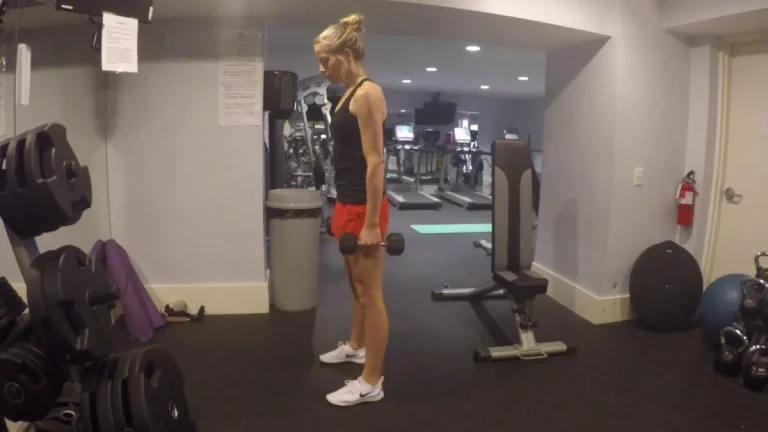
Stand with your feet about hip-width apart. Your weight should be evenly distributed through both feet, not rocked onto your heels or toes. Soften your knees slightly.
Do not lock them out.
Now set your rib cage. This is the most overlooked part of the entire exercise. Most people naturally let their ribs flare upward when they raise their arms.
That anterior tilt of the rib cage shifts the shoulder blades into a forward, elevated position. From there, every rep becomes a trap exercise.
To fix it, take a deep breath into your belly, not your chest. Exhale and gently pull your ribs down toward your hips. Think of creating a short, stable torso.
Your pelvis should stay neutral, not tucked under or tilted forward.
Finally, roll your shoulders back and down. Imagine tucking your shoulder blades into your back pockets. Hold that position throughout the entire set.
How to check your starting position
Before you lift, do a quick body scan. Your head should be in line with your spine, not jutting forward. Your shoulders should feel set, not hunched up by your ears.
Your core should feel braced like someone is about to poke you in the stomach.
Pick up the dumbbells with a neutral grip, meaning your palms face each other. Your thumbs should point forward. Let your arms hang straight down from your shoulders, not from your ears.
There should be space between your upper arms and your rib cage.
If you look in a mirror and see your ears hiding behind your shoulders, you are starting from a shrug. Reset and try again.
Step-by-Step: How to Do a Dumbbell Lateral Raise
Now that your body is set, it is time to move. Break the movement into three distinct phases: the concentric lift, the top position, and the eccentric lowering. Each phase has its own rules.
The concentric phase: leading with the elbows
From the starting position, begin raising the dumbbells out to your sides. The biggest cue here is to lead with your elbows, not your hands. Imagine you are trying to push your elbows sideways through an invisible wall.
Your hands follow behind like they are being dragged.
Keep your elbows bent at a fixed angle of about 10 to 15 degrees. Do not let that angle change as you lift. If your arms straighten or bend further, you lose tension on the delt and start recruiting other muscles.
Raise the dumbbells in a slightly forward arc, not straight out to the sides. Your thumbs should stay slightly higher than your pinkies throughout the lift, as if you are gently pouring a pitcher of water. This external rotation position protects the shoulder joint and keeps the rotator cuff in a safer alignment.
The top position: where to stop
Stop when your elbows reach shoulder height. Do not go higher. Beyond 90 degrees of abduction, the joint mechanics change and the risk of impingement increases significantly.
If you have a history of shoulder issues, stop at 80 degrees or even 60 degrees. Pain is never the goal.
At the top, your dumbbells should be roughly at ear level. Your palms should still face down, not rotated forward or backward. Pause here for one full second.
This brief pause eliminates momentum and forces the lateral delt to do the holding work.
Do not let your wrists bend back or collapse forward. Keep them in a straight line with your forearms.
The eccentric: the part most people skip
Now comes the money maker. Lower the dumbbells slowly, taking two to three full seconds on the way down. Control the weight.
Do not let gravity do the job for you.
Think about pulling your elbows back toward your hips. The slower you lower, the more muscle fibers you recruit. A study published in the Journal of Strength and Conditioning Research found that eccentric-focused training produces greater hypertrophy gains than concentric-only work, especially in smaller muscle groups like the deltoids.
Stop the descent when the dumbbells are about an inch from touching your thighs. Do not let them rest. Keep constant tension on the muscle.
That last inch of range keeps the lateral delt under load for the entire set.
Once you master these three phases, you will feel a burn in the side of your shoulder that you may have never experienced before. That is the signal that you are finally hitting the right muscle.
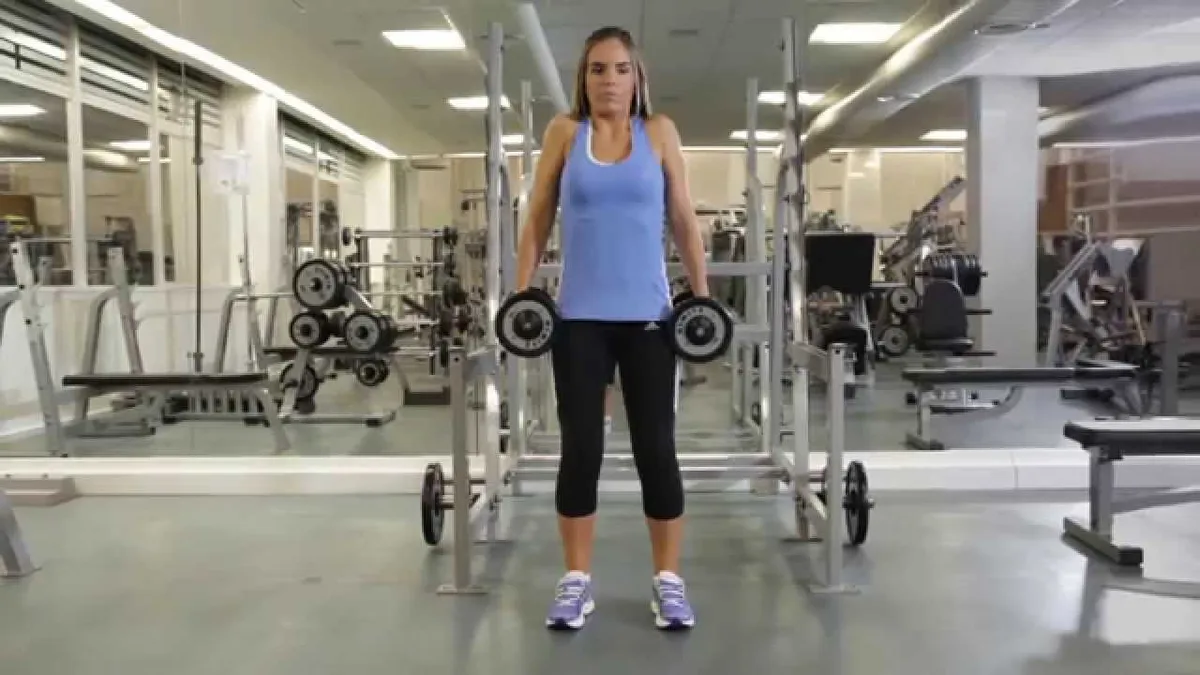
Image source: YouTube / MyTraining App (YouTube thumbnail (fair-use with source credit))
The Most Common Mistakes (and How to Fix Each One)
Even lifters who know proper form slip into bad habits. The lateral raise is brutally unforgiving of small errors. Here are the most common mistakes we see, along with simple corrections.
Shrugging the weight up
This is the number one mistake. As the dumbbells rise, the shoulders creep up toward the ears. The upper traps take over, and the lateral delts go along for the ride.
The fix: Lower the weight by at least five pounds per arm. Before each rep, consciously pull your shoulders down and back. Keep them there.
If you feel your traps burning before your side delts, you are still shrugging. Drop the weight again.
Using momentum and torso sway
Swinging the body to generate lift is another classic error. The torso rocks side to side, the lower back engages, and the lateral delt gets minimal stimulation.
The fix: Narrow your stance slightly. Brace your core as if preparing for a punch. If you still sway, switch to a seated lateral raise.
Sitting eliminates most lower body momentum and forces strict form.
Going too high or too low
Raising the dumbbells past shoulder height puts the shoulder joint in a compromised position. Stopping too early, at about 45 degrees, leaves gains on the table.
The fix: Stop when your elbows reach shoulder height. Use a mirror or film yourself to check. If you cannot see your elbows at eye level, lower the weight and focus on the full range of motion within the safe zone.
Flaring the elbows backward
When elbows drift behind the body, the movement shifts from pure abduction to horizontal abduction. That engages the rear delts and traps more, reducing lateral delt activation.
The fix: Keep your elbows slightly in front of your torso throughout the lift. Imagine raising your arms slightly forward of the midline, not straight out to the sides.
How to Choose the Right Weight
Picking the correct dumbbell weight is harder than it sounds. Too light and you get no stimulus. Too heavy and your form breaks immediately.
Warm-up sets vs. working sets
Start with a warm-up set using about 50 percent of your working weight. Do 12 to 15 controlled reps. This primes the stabilizers and reminds your brain of the movement pattern.
For your working sets, choose a weight that allows you to complete 8 to 12 reps with perfect form. The last two reps should feel challenging but not impossible. If you can do 15 clean reps, the weight is too light.
If you fail before 8, it is too heavy.
When to increase weight vs. increase reps
Progress does not always mean adding plates. Lateral delts respond well to higher rep ranges. If you can hit 12 strict reps across all sets, you have two options.
Increase the weight by two to five pounds per arm, or add one rep each set while keeping the same weight.
Most lifters benefit from staying at a moderate weight for several weeks before jumping up. The lateral delt is not built for heavy loading. Patience pays off here.
Variations Worth Trying
Once you have mastered the standard standing bilateral lateral raise, adding variety keeps your shoulders responding. Each variation changes the stimulus slightly.
Standing bilateral (standard)
This is the version we have covered so far. It is the best all around option for most lifters because it allows the most weight and works stabilizers hard.
Seated lateral raises (less momentum)
Sitting on a bench eliminates lower body momentum. Use a bench with back support to prevent leaning. This variation is excellent for strict isolation and for lifters who struggle with torso sway.
Cable lateral raises (constant tension)
Cables provide resistance throughout the entire range of motion, not just the top. The lateral delt stays under tension even at the bottom of the movement. Attach a D handle to the low pulley and stand sideways to the machine.
Grab the handle with your outside hand and raise it to shoulder height.
Leaning one-arm raises (more range of motion)
Hold a dumbbell in one hand and grab a stable vertical post with the other. Lean away from the post so your working arm hangs diagonally across your body. Raise the dumbbell out to the side.
This position allows a slightly greater range of motion and feels different from bilateral work.
How to Program Lateral Raises Into Your Routine
Lateral raises are not a primary lift. They are an isolation exercise that complements compound movements like the overhead press. That changes how you program them.
Sets, reps, and frequency
Do three to four sets of 8 to 15 reps. Rest 45 to 60 seconds between sets. Train the lateral delts two to three times per week, with at least 48 hours between sessions.
Shoulder day vs. push day placement
If you have a dedicated shoulder day, perform lateral raises after your main compound press, such as the dumbbell overhead press. If you use a push pull split, do lateral raises on your push day after chest and triceps work. Keep them toward the end of the session, when the larger muscles are already worked.
Who Should Be Careful With Lateral Raises
Not everyone is a good candidate for the standard dumbbell lateral raise. Certain conditions require caution or alternative movement patterns.
Impingement history and rotator cuff concerns
If you have a history of shoulder impingement, subacromial pain syndrome, or rotator cuff tendinitis, proceed carefully. The lateral raise can aggravate these conditions if performed incorrectly.
Start with very light weight, even five pounds per arm. Stop at 60 degrees of abduction, not 90. Use a full can position with thumbs pointing upward throughout the lift.
If you feel sharp pain at any point, stop and consult a physical therapist.
When to skip this exercise entirely
If you have a current rotator cuff tear, acute shoulder bursitis, or post surgical recovery within the last six months, skip lateral raises entirely. Replace them with pain free alternatives like prone Y raises on a bench or band pull aparts. Always follow your healthcare provider's guidance.
The Bottom Line
The lateral raise looks simple. Two arms going sideways. But the details make the difference between a shoulder building exercise and an injury waiting to happen.
One cue fixes 80 percent of form issues: lead with the elbows, keep the shoulders down. Memorize that phrase and check yourself on every rep. If your elbows are driving and your traps are quiet, you are on the right track.
The real measure of progress is not how much weight you can swing. It is how controlled your reps look on the last set versus the first. If you are lowering the dumbbells slowly, pausing at the top, and feeling the burn in the side of your shoulder, you are doing it right.
Stick with moderate weight, focus on time under tension, and your lateral delts will respond.
Frequently Asked Questions
Should I go heavier or lighter for lateral raises?
Lighter is almost always better. The lateral delt is a small muscle that responds to control and time under tension, not heavy loads. Use a weight you can handle for 8 to 12 perfect reps without swinging or shrugging.
Can I do lateral raises every day?
No. Muscles grow during rest, not during training. Train lateral raises two to three times per week with at least 48 hours between sessions.
Overtraining the shoulders leads to inflammation and impingement.
Why do my traps hurt instead of my shoulders during lateral raises?
You are shrugging the weight up. Drop the load by at least five pounds per arm and focus on keeping your shoulders depressed throughout the movement. Reset your starting position before every rep.
Should I lock my elbows during lateral raises?
Keep a slight bend in your elbows at all times. Locking them out transfers stress to the elbow joint and reduces tension on the lateral delt. A fixed 10 to 15 degree bend is ideal.
Is it okay to do lateral raises if I have shoulder pain?
Only if the pain is muscular and not sharp or pinching. If you feel a dull burn in the side of the shoulder, you are likely hitting the right muscle. If you feel sharp pain, stop immediately and consult a healthcare professional.
Here is the continuation of the article, picking up directly after the FAQ section.
How lateral raises fit into a full shoulder routine
Lateral raises should never be the star of your shoulder workout. They are the supporting act. Compound presses like the dumbbell overhead press build overall mass and strength.
Lateral raises add width and detail.
A solid shoulder session might look like this:
Dumbbell overhead press: 3 to 4 sets of 6 to 10 reps
Lateral raises: 3 to 4 sets of 8 to 15 reps
Front raises or reverse flyes: 2 to 3 sets of 10 to 15 reps
Keep lateral raises after your main press. Your delts will be pre-fatigued but still fresh enough for isolation work. If you do them first, your press numbers will suffer.
How to combine lateral raises with other dumbbell exercises
Lateral raises pair well with pulling movements. After a set of lateral raises, move straight into a set of dumbbell rows. This antagonist pairing keeps your shoulders balanced and saves time.
For example, alternate between a set of lateral raises and a set of single-arm dumbbell rows. Rest 60 seconds after each pair. The rows pull your shoulder blades back into a healthy position, counteracting the forward pull of the lateral raise.
You can also pair lateral raises with face pulls or band pull-aparts. These exercises strengthen the rear delts and external rotators, creating a balanced shoulder girdle that resists injury.
When to add lateral raises to your program
Lateral raises are safe for most lifters at any experience level. Beginners can start with two sessions per week using just 5 to 10 pounds per arm. Intermediate lifters can push to three sessions with moderate weight.
Advanced lifters can experiment with drop sets, rest-pause sets, or slow eccentrics lasting 4 to 5 seconds. But volume is not always the answer. If your shoulders feel achy or fatigued, cut back.
An extra rest day does more for growth than an extra set.
How lateral raises compare to upright rows
Upright rows target the traps and front delts more than the lateral delts. They also put the shoulder joint in a risky internally rotated position at the top. The National Strength and Conditioning Association flags upright rows as a high-risk exercise for impingement.
Lateral raises are safer and more targeted. If you want width, choose lateral raises every time. If you want trap development, use dumbbell shrugs or farmer carries instead.
Final form check before your next workout
Before you touch a dumbbell, run through this quick checklist:
Ribs down, not flared
Shoulders depressed, not shrugged
Elbows slightly bent and fixed
Lead with elbows, not hands
Stop at shoulder height
Lower in 2 to 3 seconds
One more tip. Film yourself. Set your phone on a bench or hook it on a rack.
Watch one set back. Most form issues are obvious on video but invisible in the moment. Fix what you see, then repeat.
Lateral raises are not complicated. They just demand honesty. Honesty about the weight you choose.
Honesty about your range of motion. Honesty about whether your traps or your delts are doing the work. Nail those details, and your shoulders will grow.